Built for the paperwork behind every first appointment
OTeva started from a simple complaint every pediatric OT practice shares: the intake questionnaire, the caseload spreadsheet, and the Initial Evaluation report all live in different places, and none of them talk to each other.
Why it exists
A pediatric occupational therapist's first weeks with a new patient are mostly paperwork: a caregiver intake form, a developmental history, a stack of prior evaluations, and eventually a formal Initial Evaluation SOAP report that has to reconcile all of it. OTeva keeps that entire arc, patient record, questionnaire, and report, in one place, and uses AI only where it actually saves time: turning a caregiver's answers into a structured Subjective section instead of re-typing them.
It runs entirely on the device it's installed on. There's no account to create and no server storing patient data, because a tool that handles protected health information shouldn't need either.
A fingerprint made of puzzle pieces
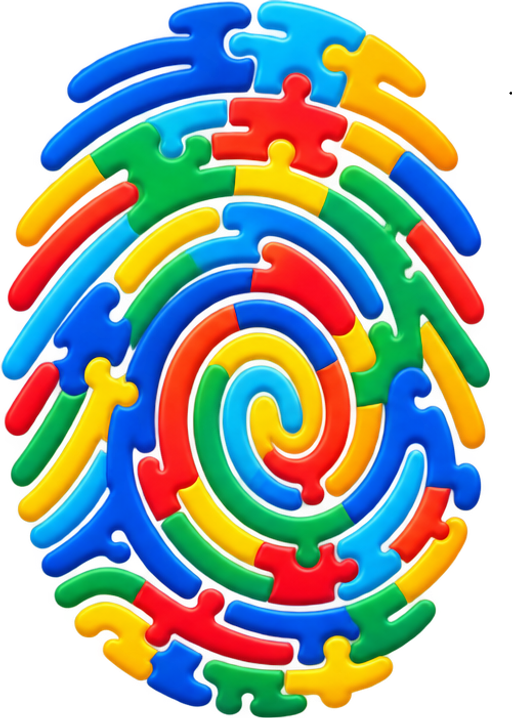
The OTeva mark fuses two ideas that already belong together in pediatric OT: a fingerprint, the universal symbol of individual identity, and a puzzle piece, the long-standing motif for developmental and autism awareness. The fingerprint's spiral ridges are built out of interlocking puzzle-piece shapes, so the two readings are inseparable at a glance.
The mark uses all four established autism-awareness puzzle colors together, rather than picking one as "the brand color." No single hue owns the identity; it only reads as itself when all four interlock, blue, red, amber, and green, the same way a care team, a treatment plan, and a family's daily routine only work when their parts fit together.
What "OTeva" means
The wordmark carries the same idea: each letter is colored individually instead of using one flat brand color.
- O, T: Occupational Therapy, the discipline the practice is built on.
- e: Evaluation, lowercased to soften the clinical acronym into a name.
- v, a: complete the word and carry the remaining two puzzle colors.
How it's built
OTeva is a desktop-first app (Next.js, with a Tauri shell in progress) that stores every patient, assessment, and catalog record in the browser's local storage on the device it's installed on. AI drafting is optional and provider-agnostic: Anthropic, OpenAI, Gemini, or a local Ollama endpoint, configured with your own key in Settings.
Read more about the day-to-day workflow in the documentation, or see the actual product in the screenshot gallery.